
Joint SENTRO and LEARN Statement on the on the ₱40-Billion loss for the SSS
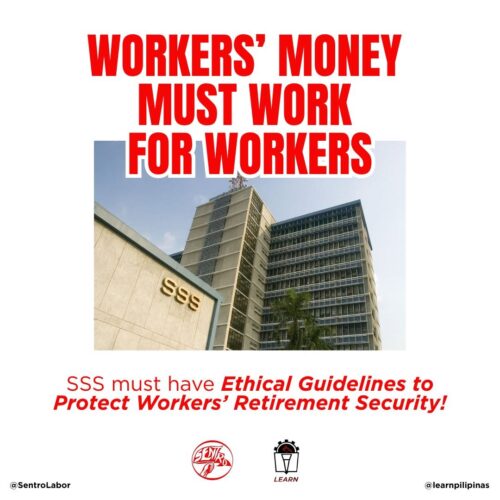 In a country where insecurity is the main problem of most people – food insecurity, financial insecurity, job insecurity – it is unsurprising that reports stating a ₱40-billion in paper loss for the Social Security System (SSS) caused widespread concern among workers. Clearly, Filipinos have little confidence on our government. How can we trust our institutions when the flood control investigations went nowhere? How can we trust our leaders when the Vice President herself is facing serious impeachment charges over massive corruption?
The problem for the SSS is the same problem faced by government as a whole – how can they convince the people to trust the institutions handling their hard-earned money?
The Sentro ng mga Nagkakaisa at Progresibong Manggagawa (SENTRO) and the Labor Education and Research Network (LEARN) call on the Social Security System (SSS) to adopt comprehensive ethical investment guidelines as a guide for handling workers’ contributions.
A clear policy that assesses investments not just for maximizing profit, but as instruments accountable to social, environmental, and humanitarian considerations will help ensure that workers’ contributions are invested prudently, responsibly, and transparently.
If the SSS expects workers to trust it with their retirement security, it must be accountable not only for how much their money earns, but also on how that money is invested. What better way to guarantee this than by clearly aligning investment priorities with internationally recognized labor and human rights standards?
This demand is all the more urgent given the reported ₱40-billion in paper losses flagged by the Commission on Audit (COA), the SSS’s defense of its equity investments, and its plan to place 5% of its Investment Reserve Fund (IRF) in foreign instruments by the end of 2027.
To be fair, we recognize that paper losses are not necessarily realized losses and that diversifying investments can be a legitimate strategy for managing risk.
However, neither diversification nor the pursuit of higher returns absolves the SSS of its responsibility to demonstrate that workers’ contributions are being managed according to clear, transparent, and accountable standards. To this end, ethical investment must be part of the SSS’s fiduciary responsibility, not an optional consideration.
We call on the Social Security Commission to establish binding investment guidelines that integrate respect for labor rights, human rights, environmental responsibility, and sound corporate governance into investment decisions. These should cover both domestic and foreign investments. There must also be a clear criteria for identifying unacceptable practices, conducting due diligence, engaging companies to remedy violations, and excluding investments when serious abuses persist.
Our demands are not unreasonable or unrealistic. Major pension funds abroad, including California’s Public Employees’ Retirement System (CalPERS) and Norway’s Government Pension Fund Global, demonstrate that institutional investors can incorporate ethical considerations into investment policies while maintaining a focus on long-term financial performance.
The Philippines should develop its own framework suited to our circumstances, drawing on these experiences and internationally recognized standards.
The SSS must also provide greater transparency on its investment portfolio, performance, management fees, and material risks. The public deserves a clear accounting of the paper losses flagged by COA, the investment decisions behind them, and the safeguards in place to prevent excessive risk-taking. Workers and pensioners, whose contributions sustain the fund, must have a meaningful voice in shaping and reviewing these policies.
The SSS is entrusted with workers’ contributions (taken from years of labor and as a social obligation) not simply to grow the fund, but to safeguard the retirement security those contributions are meant to provide.
Finally, beyond protecting the fund from financial and reputational risks, responsible investment should also consider how pension assets can contribute to a more productive Philippine economy. Where financially sound and consistent with the fund’s obligations, investments that support decent jobs, renewable energy, and domestic productive capacity can help strengthen the economic foundations that Social Security depends on.
Workers’ money must work for workers. The SSS must show that it can protect their pensions, uphold their rights, and invest responsibly for the future.
