
LEARN Response to World Bank Announcement that Philippines Reached “Upper Middle Income” Status
Recently, the Philippines has been classified by the World Bank as an “Upper Middle Income” country. We now join a growing number of developing economies that have a GNI per capita between $4,496 and $13,935. While the Marcos Jr. administration maximizes the opportunity to announce that its policies and governance works, the everyday reality of working people tells a different story — a story of poverty, insecurity, chronic stress, and terrible public services.
Claims by Finance Secretary Frederick Go that “The Philippines’ transition to an upper middle income country is an affirmation of the reforms and policies that the government has consistently pursued to strengthen our economy and to create more opportunities for our people,” needs to be carefully scrutinized.
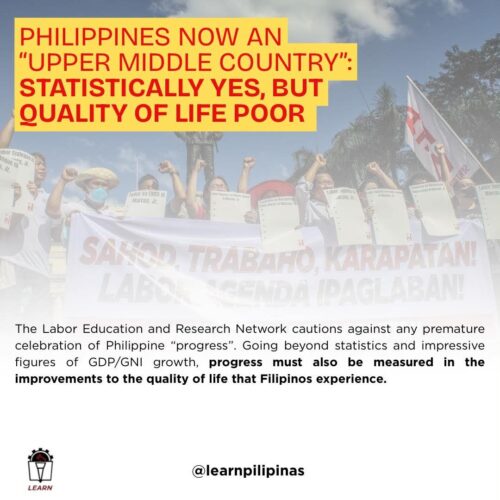
The Labor Education and Research Network (LEARN) cautions against any premature celebration of Philippine “progress”. Going beyond statistics and impressive figures of GDP/GNI growth, progress must also be measured in improvements to the quality of life that Filipinos experience.
According to the Social Weather Station, last March 2026, self-rated poverty was a dismal 52%. Self-rated food poverty meanwhile remained troubling at 42%. Workers still suffer from poverty wages. The “historic” wage hike in the NCR that DOLE Secretary Tolentino bragged about is a pathetic 85 pesos increase — in a further insult to workers, this would be implemented in two tranches. This is nowhere near the minimum 200 peso wage hike that labor unions are pushing for wage recovery. To hear that the country is getting wealthier while workers still cannot recover the value of their wages — much less actually increase its real value —is difficult to accept. The present situation only deepens distrust at the government and the big businesses that profit while the majority suffer.
The government’s claim of success reveals that it is severely out of touch with the everyday realities that the majority of Filipinos experience. The celebratory tone brings to mind statements by government executives that the worsening traffic paralyzing our cities should be seen as a “positive sign” of economic growth. These pronouncements, heard from the previous Aquino III and also the Marcos Jr. administration, are so alien and different to our actual lives.
LEARN strongly doubts that the people stuck in traffic, the riders struggling to breathe in clogged underpasses, and the commuters desperate for a ride home actually believe that things are improving. Until the supposed “prosperity” of the nation is actually felt by the majority through proactive policies such as a living wage, public employment, and genuine industrial policy, claims that we are getting richer are hard to believe. Perhaps the people living in Forbes Park and BGC are doing well, but the rest of the country definitely isn’t.
