
The US empire continues to cast a long shadow over the people of Latin America. Since the Monroe doctrine, to clandestine machinations during the Cold War and beyond, the struggle for liberation in this continent has always been a struggle against both local elites and the United States. In this context, democracy is not just a matter of process, it is a question of substance. Who holds power? The people? A colonial master? Dictators who claim to speak on behalf of their nation? For Latin American workers and social movements, answering this question continues to shape the continent’s history. Today, the brazen acts of US imperialism brings this question to the fore once again.
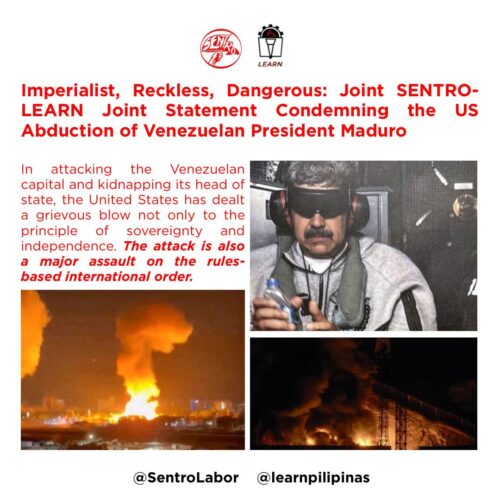
The Labor Education and Research Network (LEARN) and Sentro ng mga Nagkakaisa at Progresibong Manggagawa (SENTRO) strongly condemn the recent abduction of Venezuelan President Nicolas Maduro and the First Lady Cilia Flores by United States forces last night, January 3rd. In attacking the Venezuelan capital and kidnapping its head of state, the United States has dealt a grievous blow not only to the principle of sovereignty and independence. The attack is also a major assault on the rules-based international order. This very order was formed in the wake of two devastating world wars sparked by nations operating on the principle of might makes right. Viewed in this light, the American operation in Caracas is simultaneously an issue of democracy (Trump acted unilaterally without authority from Congress), colonialism, and geopolitical tension.
For LEARN and SENTRO, the impunity with which American officials planned and conducted the abduction of a head of state revives the specter of colonialism that defines the US’ relationship with Latin American countries.
Despite its flaws, the Bolivarian experiment is still an example of state-led development that runs against neoliberal orthodoxy. With Trump saying that the US will “run Venezuela”, we can expect that Washington plans to demolish the public sector and enforce neoliberal policies on the country. This will inevitably give free reign to the private sector, especially transnational US corporations, at the expense of working people.
What has transpired before the world is nothing more than a blatant attempt at regime change to secure the political and economic interests of the US empire.
More dangerously, the American example might encourage other powers to violate the international system governing the behavior of States. If the United States could simply remove a head of state in a county it views as under its sphere of influence, what’s stopping continued Russian aggression in Ukraine? Chinese moves in Taiwan? What does the American example mean for the thousands of political exiles that their emboldened governments might attack? If a sitting president can be arrested by another nation, how much more dissident journalists, unionists, and activists?
It is for this reason that LEARN and SENTRO are greatly worried by the repercussions of this unilateral American action. Despite the obvious failures of multilateral institutions, a retreat from the noble vision of the United Nations is detrimental to democracy, human rights, and the spirit of human solidarity.
For the international trade union movement, the events in Latin American must be viewed with great concern. We must view this as intimately connected with attempts to silence workers and suppress self-determination in Ukraine, Myanmar, and the present maritime tensions in Southeast Asia.
To borrow from Vaclav Havel, when the dignity of workers is crushed in Venezuela, does that violence not echo across borders, striking the dignity of the working class everywhere?
We call on workers, social movements, and all peace-loving peoples to condemn the US action. We also call for the reform of the existing multilateral order to reflect the original vision articulated in the foundation of the United Nations.