LEARN Statement on 2026 February LFS
At surface level, the February 2026 Labor Force Survey (LFS) shows an improvement in the labor market compared to January. But yearly observations reveal the declining national performance in supplying quality jobs.
This is a trend that can be observed across the data: Higher employment, lower unemployment, and lower underemployment from January, but all still underperforming compared to February last year.
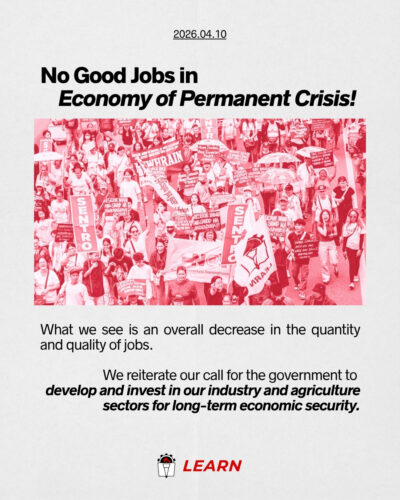
At best, the data shows an uptick in the labor market. However, closer examination would prove this to be part of the seasonal trends in jobs which we have long observed. Instead, what we see is an overall decrease in the quantity and quality of jobs.
Services dominate the job market at the expense of agriculture and industry — a constant trend for years.
Industry in particular has shrunk from 18.3% to 17.7% since last year, while the agricultural sector bled around 523,000 jobs this year. Both sectors have a key role in ensuring that we build a competitive national economy resistant to economic shocks such as the current oil crisis, Investment in the industrial sector for example could curb the decline in the power of the Philippine Peso by having a larger value capture of global supply chains that we are already part of, while a robust and developed agricultural sector would help ensure food security.
Instead, the year to year comparison shows administrative and support services seeing the biggest increase in employment, including temporary employment and offshore services. We also see greater insecurity in employment because of the temporary nature of work in the sector.
All of these conditions leave us sorely unprepared to face the current worldwide crisis: The ongoing war between US-Israel and Iran could result in major repercussions for the energy sector, with a potential ripple effect across the economy, particularly on the cost of living crisis already biting many. Assurance of the Iranian Government allowing Philippine-bound vessels to pass through the Strait of Hormuz for much-needed fuel will relieve some of these impacts. However, this on its own will not solve all of the pressures we are facing. Beyond quick fixes and dependence on external developments, the Philippine government needs to take strategic steps to ensure economic stability in the face of current and future uncertainties.
It is because of this that LEARN calls for a change in national labor strategy: Shift from market-led interventions to proactive people-centric responses. We reiterate our call for the government to develop and invest in our industry and agriculture sectors for long-term economic security. As the 21st century promises many uncertainties and challenges to the nation, we cannot afford to be nearsighted in industrial policy.
