Statement of LEARN on President Marcos Jr.’s Acknowledgement of an Oil Crisis
Almost a month since geopolitical tensions in the Middle East exploded into another war between Iran and the United States and Israel, the Philippine government continues to be sluggish in addressing Filipino’s urgent concerns. As motorists — from the well-off SUV driving middle classes, to the motorcycle riding working masses — began a mad rush to gas stations, the government continued to pretend that everything was normal.
No less than president Marcos Jr. himself repeatedly said for weeks that there was no crisis in our oil supply, until he suddenly declared a “national energy emergency”.
With an unreliable government and rising pressures on the cost of living, it is understandable for Filipinos to respond with a wide range of emotions. One of these is to turn on each other for the perceived unevenness of the government’s relief programs. However, to blame the working poor for “ayuda” or to demand the same for the middle classes misses the point.
The entire nation is struggling, and the precariousness of the “privileged” middle class may be a sign that they share many similarities with the working poor after all. Perhaps the working class is broad enough to include the professional graphic designer, BPO worker, and the tricycle driver. Targeted “ayuda” programs are necessary, but they are insufficient in the absence of a comprehensive package of programs and reforms.
Instead of arguing who deserves assistance more, LEARN believes that the people’s energy is better spent pushing the State for a strategic response to the present crisis. Together with trade unions, social movements, and civil society, we join the call to review the oil deregulation law and improve the government’s ability to directly intervene in economic decision-making. Doing so could provide the government with an important tool for mitigating the pressure caused by supply disruptions and shocks.
As we continue to provide emergency relief to transport workers and low-income households, it is important that we ensure food security by providing subsidies and adequate services to farmers who also face rising fertilizer prices due to the supply shock.
Beyond short-term ayuda programs, we believe that it is time for the government to develop a serious public employment program, and actually take steps to formulate the agro-industrial policy required to generate good, quality jobs. Given our vulnerability to the climate crisis and disruptions to oil supplies, these policies must be geared towards developing and expanding renewable energy sources.
As these short and long-term interventions require funding, the move to suspend excise taxes might do more harm than good. Rather than cut existing funding sources, LEARN argues that a wealth tax for the country’s ultra wealthy would go far in raising the revenues to adequately support state support for all Filipinos.
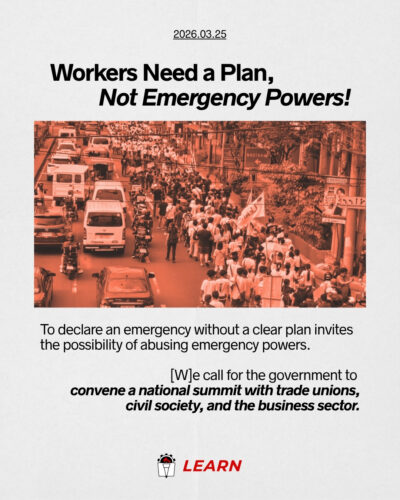
Finally, the declaration of a national energy emergency is a recognition of the current crisis, but it raises more questions than answers. To declare an emergency without a clear plan invites the possibility of abusing emergency powers. In the wake of the unresolved flood control scandal, it is doubtful if Filipinos can trust the administration with this increased discretion. Furthermore, existing laws and policies already give the government the mandate to implement many of the actions that the emergency declaration calls for. Why then is the declaration necessary?
Whatever national strategies will be developed must be done through a consultative, people-centric approach. Instead of ambiguous announcements of emergency power, we call for the government to convene a national summit with trade unions, civil society, and the business sector. Developing responses with the active participation of the people bearing the brunt of the crisis will help ensure that interventions are relevant to the people’s needs, and accurately reflect our concerns and interests.
